
Florida Career College to Close

Florida Career College to Close Doug Lederman Fri, 01/26/2024 - 03:00 AM Byline(s) Doug Lederman from Inside Higher Ed https://ift.tt/avZRfLi

CDC Cites Rise in Young Adults With COVID-19

The number of young adults with COVID-19 rose by 55 percent from early August to early September, as most colleges were bringing students back to their campuses, the Centers for Disease Control and Prevention said in a new report published Tuesday.

The federal agency's "Morbidity and Mortality Weekly Report" found that the incidence of COVID cases among people aged 18 to 22 years increased by nearly 63 percent from Aug. 2 to Aug. 29, then dropped off slightly through Sept. 5, accounting for the 55 percent rise. The increases were greatest in the Northeast (144 percent) and Midwest (123 percent). The increases were particularly sharp among white young adults, as seen below.
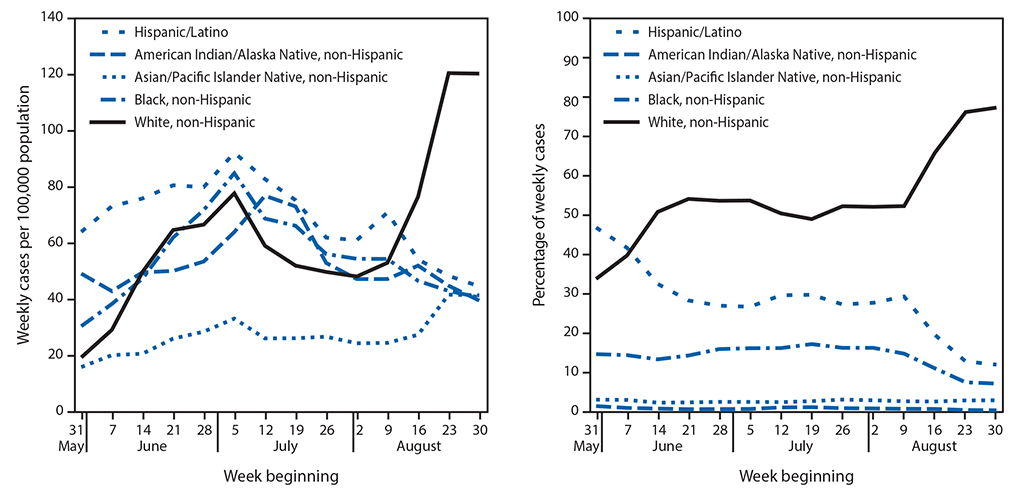
https://www.cdc.gov/mmwr/volumes/69/wr/figures/mm6939e4-F3.gif

The CDC study includes its usual disclaimer that the increases in cases "were not solely attributable to increased testing."

The report suggested that multiple factors are likely at play, but said, "Because approximately 45 percent of persons aged 18-22 years attend colleges and universities and 55 percent of those attending identified as white persons, it is likely that some of this increase is linked to resumption of in-person attendance at some colleges and universities."

It concluded by stating, "Mitigation and preventive measures targeted to young adults (e.g., social media toolkits discussing the importance of mask wearing, social distancing, and hand hygiene), including those attending colleges and universities, can likely reduce SARS-CoV-2 transmission among their contacts and communities. Institutions of higher education should support students and communities by taking action to promote healthy environments."

Editorial Tags: 
Is this diversity newsletter?: 
Disable left side advertisement?: 
Is this Career Advice newsletter?: 
Live Updates: 
liveupdates0


from Inside Higher Ed https://ift.tt/2SaaoXF

Comments

Popular posts from this blog

Why Is Middle School So Hard for So Many People?

Middle school. The very memory of it prompts disgust. Here’s a thing no one’s thinking: Geez, I wish I still looked the way I did when I was 12. Middle school is the worst. Tweenhood, which starts around age 9 , is horrifying for a few reasons. For one, the body morphs in weird and scary ways. Certain parts expand faster than others, sometimes so fast that they cause literal growing pains; hair grows in awkward locations, often accompanied by awkward smells. And many kids face new schools and a new set of rules for how to act, both socially and academically. But middle school doesn’t have to be like this. It could be okay. It could be good , even. After all, middle schoolers are “kind of the best people on Earth,” says Mayra Cruz, the principal of Oyster-Adams Bilingual School, a public middle school in Washington, D.C. The notion that middle school deserves its own educational ecosystem at all dates back to the 1960s , with a campaign to better accommodate the specific learning ne...

The global significance of fossil fuel divestment (opinion)

Warning lights are flashing. “It’s now or never, if we want to limit global warming to 1.5°C (2.7°F),” cautioned Jim Skea, the co-chair of the United Nations’ Intergovernmental Panel on Climate Change working group on climate change mitigation. “Without immediate and deep emissions reduction across all sectors, it will be impossible.” The IPCC states unequivocally in its April 2022 report that human behaviors have warmed the globe, and that—to limit warming to 1.5 degrees Celsius—drastic action is needed to cut greenhouse gas emissions 43 percent by 2030. This will require “a substantial reduction in fossil fuel use … and [increased] use of alternative fuels.” Universities and colleges throughout the world have been responding to the crisis. Scholars have carried out essential climate research from a variety of disciplinary perspectives, students have mobilized to push universities toward divestment from fossil fuels and alumni have joined the movement, even launching ...